A tribute to the 1st Amendment.
Wednesday, August 19, 2009


Science is Kool and Why My Niece is so Advanced

My Son and his Cousin (my niece) love each other. It's really very sweet. They love each other in the way only a three and a half year old and a four year old can love each other. They run to each other, they embrace freely and chase each other into a frenzy. They keep up with each other throughout the day at a pace that exhausts any witness to their reunions. Throughout the day some differences become apparent: princesses and baseball. Though my niece is game and enjoys her time at bat and my son will push a doll around the house in a stroller, their minds quickly wander to their own areas of interest.
It's at the end of the day where my niece enjoys a competitive advantage in the game to see who can play longer. As they get ready for bed and get tucked into the upper and lower levels of the trundle bed my son is justifiably exhausted; my niece, who should be tired, has a gleam in her eye and through the intercom we hear her whispering for my son to wake up and play at 11:00 PM. She wakes him at 6. She is invincible and my son is exhausted. Why the difference, I had no idea until the Times laid it out for me. My niece is the next rung on the evolutionary ladder. Or a mutant, but she's such a cute kid I'd hate to use that label. Can you imagine if this mutation becomes more prevalent, a small group of people (led by my niece) may take over the world because they are awake and feeling refreshed at 4:30 in the morning while the rest of are still asleep. In a pre-dawn offensive the world could change because of these new less fantastic X-Men.
It's at the end of the day where my niece enjoys a competitive advantage in the game to see who can play longer. As they get ready for bed and get tucked into the upper and lower levels of the trundle bed my son is justifiably exhausted; my niece, who should be tired, has a gleam in her eye and through the intercom we hear her whispering for my son to wake up and play at 11:00 PM. She wakes him at 6. She is invincible and my son is exhausted. Why the difference, I had no idea until the Times laid it out for me. My niece is the next rung on the evolutionary ladder. Or a mutant, but she's such a cute kid I'd hate to use that label. Can you imagine if this mutation becomes more prevalent, a small group of people (led by my niece) may take over the world because they are awake and feeling refreshed at 4:30 in the morning while the rest of are still asleep. In a pre-dawn offensive the world could change because of these new less fantastic X-Men.
Just think of their advantages. They can stare at you while you sleep and examine your numerous flaws, the chinks in your armor. They can read the morning paper before you and redact the portions they don't want you to know about. They can eat breakfast while you sleep and be ready for lunch when you are eating breakfast, they may always be a meal ahead. So maybe the advantages of this mutation are not as far reaching. But what if the mutation becomes more prevalent. If one third of the world was awake and ready for work at 5 in the morning what else would change. It's too horrible to think about.
I know that technically the mutation may not be an evolutionary development but how incredible would it be if it was. A mutation influenced by the amount of time needed to accomplish a day's work would be an incredible development. It would almost be a little sad if we discovered the mutation only affected Americans. Other organisms have made adaptations which make the sleep thing look like a lame card trick. Several months ago a friend posted this link to his facebook page. I read it, thought it was cool, then forgot about it. Then I watched "The Happening." It is not a good movie but it was not so horrible that it has been denied full rotation on the HBO networks. For those who have not seen it, the premise is that foliage develops a neurotoxin that it releases into the wind which affects human brains in such a way that anyone exposed to the toxin commits suicide. Pretty cool. Well it was cool when it was a joke of a movie. Not so funny when you find out that fungus already does this to insects. That's right, there is mind control fungus which forces ants to die facing certain directions and at certain heights. All of my sister's theories about sharks taking over the world now pale in comparison to the threat posed by Ophiocordyceps unilateralis. For now, they only threaten ants but it can only be a matter of time until we are laying face down, biting a leaf on the north side of a tree. Who will protect us from the fungus among us? (Picture is property of The American Naturalist/University of Chicago Press)
 sad if we discovered the mutation only affected Americans. Other organisms have made adaptations which make the sleep thing look like a lame card trick. Several months ago a friend posted this link to his facebook page. I read it, thought it was cool, then forgot about it. Then I watched "The Happening." It is not a good movie but it was not so horrible that it has been denied full rotation on the HBO networks. For those who have not seen it, the premise is that foliage develops a neurotoxin that it releases into the wind which affects human brains in such a way that anyone exposed to the toxin commits suicide. Pretty cool. Well it was cool when it was a joke of a movie. Not so funny when you find out that fungus already does this to insects. That's right, there is mind control fungus which forces ants to die facing certain directions and at certain heights. All of my sister's theories about sharks taking over the world now pale in comparison to the threat posed by Ophiocordyceps unilateralis. For now, they only threaten ants but it can only be a matter of time until we are laying face down, biting a leaf on the north side of a tree. Who will protect us from the fungus among us? (Picture is property of The American Naturalist/University of Chicago Press)
Saturday, August 15, 2009
Deposition in St. Petersburg and Mutiny

Unfortunately this seems to be a pattern. I don't post for a long time and then find myself with a private moment where I can jot something down. Current Facebook Status: sitting in a court reporter's office in St. Petersburg, Florida with some time to myself. I just got back from a short walk up and down Central Avenue. There are a lot of closed storefronts, a lot of homeless folks, some new trendy restaurants and plenty of parking. There are some older coffee shops and restaurants on the street that I wish I had time to try, but I didn't. There are also a ton of music venues I can remember going to with friends when I was in college. I listened to my iPod throughout my stroll and was pleased to hear "Wanna be Startin Something" by MJ (so glad I put Thriller on this contraption). After MJ was a version of "Rawhide" by Ricky Skaggs, then Shlomo Artzi.
I really couldn't prepare anymore for the witness. The room I was in was vintage shared corporate office space. There was a painting of a tree done in three colors, red white and black that was reminiscent of every garage sale ever conducted, 4 glass jars of candy (I have had two caramels, not Kraft), 1 Costco sized container of UTZ holiday shaped pretzels (the holiday was clearly Christmas with pretzels in the shape of Christmas trees). There were also the obligatory colored drawings of St. Pete/Tampa landmarks of which I recognized none, though one may have been the Stetson Law School campus in Gulfport. My iPod then switched to "Last Date" by Floyd Cramer and I wondered if all the oohs and ahs in the song mean it's not an instrumental piece. There is a TV in the corner with a mounted apparatus for video conferencing which we won't need today. The receptionist just told me I can't park where I parked so I move my car wondering how she knew where I parked.
The deposition lasted too long and without revealing any details let me just say that the witness is a horrible person. I actually think he is a sociopath and who has been taking advantage of weaker people his whole life with impunity. In fact, this case, this current deposition is not being taken about those issues, he is a mere fact witness and my questioning is no deterrence to his future activities. Worst of all, he is not alone. Though I cannot mention details I only say that this man's behavior is part of a larger conspiracy and I am immediately reminded of the men of the Pitcairn Islands.
The Pitcairn Islands are where the descendants of Fletcher Christian (leader of the mutineers of the HMS Bounty) settled after setting Captain William Bligh adrift on rowboat. It's an incredible true story, as documented by numerous websites, that far surpasses the romanticized versions of the films. I have never seen the 1962 version but we can all picture the later incarnation with Mel Gibson and Anthony Hopkins. The movie also has Daniel-Day Lewis, Liam Neeson and an aged Lawrence Olivier as the admiral. I've digressed. The thing about the movie and its predecessors is that they are bullshit. There was no falling in love with Tahitian women, there was the kidnapping of Tahitian women. The mutineers kidnapped as many women as they could and settled on Pitcairn Island establishing their own society.
The settlers were left alone for their part without the judgment of the world to affect their habits and until relatively recently they sexually abused all the young girls who had the unfortunate fate of being born to a Pitcairn family. I suggest listening to the interview at the link with Kathy Marks who wrote "Lost Paradise" about the trial of the Pitcairn men. In summary, these islands with a population which hovers around 50 have created a tradition out of having sex with with the islands' young women against their will. Nobody says anything and the practice has continued for as long as the residents remember. I should mention that the Pitcairn Islands are a British Overseas Territory. They are part of the British Empire, but they are also so far from anything and everything that their connection to the world around them has been for most of the society's existence, tenuous at best. Just read Ms. Mark's telling of how to reach the island:
"Ms. MARKS: Pitcairn, in 2009, still has no airstrip, not even a safe harbor. I traveled there from Australia. It took about a week to get there.
DAVIES: A week.
Ms. MARKS: A series of flights from Australia, followed by a very rough, 30-hour boat voyage from a distant corner of French Polynesia. Now, having made that rather grueling journey, you then anchor about a mile off Pitcairn and wait for the island's men to bring out the longboat. That's the only way of getting on and off the island still - is the traditional boats that the men steer.
What I found curious when I first arrived in 2004 to report on the first trials of Pitcairn men, the islanders brought out their longboat - it drew up alongside us and I was quite astonished. I looked out and saw that the two men who were driving the longboat were two of the men who were about to go on trial for very serious child sex offenses. And I thought gosh, this is going to be quite an unusual assignment, and this is quite an unusual place."
If you familiarize yourself with the story you'll learn that ultimately several of the men were ultimately punished for their crime despite the punishments being woefully inadequate. But the men were only found out because a British policewoman was stationed on the island who was confided in by a 15 year old girl. What's more shocking about the story is that women who had left Pitcairn did not speak up until after the case of the 15 year old was being investigated. ( I assume, not trying to blame the victims here). Pitcairn was a place dominated by men because of its rugged and harsh existence and the confluence of isolation and dominance led to a tragic outcome. But there is no remorse on Pitcairn because they don't believe they've done anything wrong. One can imagine the pleas of Pitcairn men not to be saddled with the judgment of the outside world. The lesson we should all take away form this story is that isolation leads to bad things. Cruel things. And a compromised set of values unhindered by a watchful eye.
We can see it in smaller ways in our own society when we consider isolation by economic means, by race, religion and political persuasion. It may be many people's dream to have that large piece of property with no neighbor in sight but in my opinion it does more harm than we imagine. Let's all live in one giant condo, they are really cheap right now.
Thursday, December 4, 2008
Friday, November 21, 2008
Saturday, November 15, 2008
Diary of a Third Party Bad Faith Trial (This Will Be Boring)
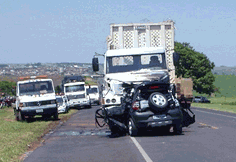
We recently went to trial in a common law third party bad faith case in Hillsborough County, Tampa, Florida. It was a rare occurence because the risk involved with a bad faith trial usually pushes the insurer to settlement. A brief primer on insurance bad faith and the difference between third and first party cases would be helpful for understanding this post, luckily I already wrote one. In the first party context there are often issues at play which can inflate the value of a case against an insurer which are not present in a third party case. Furthermore, damages are usually limited in a third party bad faith case to the extent of the excess judgment in the underlying case. For example, if you have an insurance policy with $10,000.00 in bodily injury coverage (like most auto policies in Florida) and your insurance company misses an opportunity to settle a case against you within that $10,000.00, the excess judgment of the Plaintiff from that underlying case is the most that can be recovered in a bad faith case against the insurer; e.g., if the Plaintiff was awarded $110,000.00 at the underlying trial of the injury claim then the total exposure for the insurer in a common law third party bad faith case would be $100,000.00. Generally, (there may be some exceptions), the jury does not determine the amount of the award in the common law third party bad faith case because the jury from the underlying case has already set the value of the damages; the common law third party bad faith jury is only charged with determining whether an insurer acted in bad faith, yes or no.
This is a tremendous advantage over a first party situation where a bad faith jury could be determining values for additional damages related to an insurer's failure to treat it's own insured fairly. Because there is no opportunity for a jury to negotiate a value among its members, I believe that the third party scenario presents a problem for jurors resulting in a hung jury, assuming that you can convince a single stalwart juror that the insurer has acted reasonably. Alternatively, the third party bad faith case presents a problem for the Plaintiff because a single factor in favor of the insurer may prevent a Plaintiff's verdict. I've digressed, back to the case at hand.
This is a tremendous advantage over a first party situation where a bad faith jury could be determining values for additional damages related to an insurer's failure to treat it's own insured fairly. Because there is no opportunity for a jury to negotiate a value among its members, I believe that the third party scenario presents a problem for jurors resulting in a hung jury, assuming that you can convince a single stalwart juror that the insurer has acted reasonably. Alternatively, the third party bad faith case presents a problem for the Plaintiff because a single factor in favor of the insurer may prevent a Plaintiff's verdict. I've digressed, back to the case at hand.
Our recent trial mirrored a specific kind of common law third party bad faith scenario wherein there are multiple claimants against in insureds limited policy proceeds. Florida courts have dealt with the situation previously and one case in particular has laid out an insurer's specific duties in a multiple claimant situation, Farinas v. Florida Farm Bureau. Generally, an insurer has to attempt to resolve as much exposure for their insured as possible and must act to achieve that goal by reasonably investigating the claim and keeping their insured advised throughout. The Farinas case also mentions that a good way to try and resolve all the claims might be to schedule a mediation inviting all the claimants, presumably to have them reach an amicable split of the insurance proceeds.
In our case there had been four serious injuries. The three potential claimants in the insured's vehicle, plus one potential claimant from the other car in the accident. The three potential claimants from the insured's vehicle all had serious injuries, broken bones, hospital stays, and astronomical medical bills; the claimant from the other vehicle had some knee pain and a surgical recommendation for an ACL repair. Predictably, there was not enough money to go around as the insured had $50,000.00 in aggregate liability limits (considerably more than most people but woefully insufficient to fully compensate any of the claimants for their injuries). The carrier in our case conducted an investigation, reviewed the accident report, interviewed the participants, sent correspondence to all the parties, and considered who was at fault. They hired defense counsel for their insured, kept the insured informed, and scheduled a mediation where they attempted to settle all of the claims within the $50,000.00 limit.
The single claimant (with the least serious injuries) walked away from mediation without a settlement and pursued her claim against the insured. She ultimate received a judgment against the insured approaching $90,000.00. The other three claimants allowed the insurance company to retain a few thousand dollars from the 50k to try and settle with the one claimant who would not settle at mediation. This is where the greatest problem in a Farinas style bad faith case arises, how do you prove what occurred at mediation, specifically, that an offer and attempt to settle all the claims actually took place. Florida Courts like those in many states have been loathe to invade any mediation privilege (an earlier statute in Florida only kept mediation which was conducted during litigation confidential); so an insurer is seemingly without recourse to prove that reasonable attmepts to settle all claims took place at a mediation. As the insurer did in our case, all of the correspondence prior to mediation and afterwards should indicate that it is the purpose of the mediation to settle "all of the claims." This is also the province of a "bad faith expert" who can explain the purpose of the mediation as well as the reasonableness standard for investigation and communication with the client. The jury must/should conclude that the insurer would not have invited the claimant to the mediation if they did not intend to settle with the individual. A jury of laypeople unfamiliar with the process may not take that step.
In our case there had been four serious injuries. The three potential claimants in the insured's vehicle, plus one potential claimant from the other car in the accident. The three potential claimants from the insured's vehicle all had serious injuries, broken bones, hospital stays, and astronomical medical bills; the claimant from the other vehicle had some knee pain and a surgical recommendation for an ACL repair. Predictably, there was not enough money to go around as the insured had $50,000.00 in aggregate liability limits (considerably more than most people but woefully insufficient to fully compensate any of the claimants for their injuries). The carrier in our case conducted an investigation, reviewed the accident report, interviewed the participants, sent correspondence to all the parties, and considered who was at fault. They hired defense counsel for their insured, kept the insured informed, and scheduled a mediation where they attempted to settle all of the claims within the $50,000.00 limit.
The single claimant (with the least serious injuries) walked away from mediation without a settlement and pursued her claim against the insured. She ultimate received a judgment against the insured approaching $90,000.00. The other three claimants allowed the insurance company to retain a few thousand dollars from the 50k to try and settle with the one claimant who would not settle at mediation. This is where the greatest problem in a Farinas style bad faith case arises, how do you prove what occurred at mediation, specifically, that an offer and attempt to settle all the claims actually took place. Florida Courts like those in many states have been loathe to invade any mediation privilege (an earlier statute in Florida only kept mediation which was conducted during litigation confidential); so an insurer is seemingly without recourse to prove that reasonable attmepts to settle all claims took place at a mediation. As the insurer did in our case, all of the correspondence prior to mediation and afterwards should indicate that it is the purpose of the mediation to settle "all of the claims." This is also the province of a "bad faith expert" who can explain the purpose of the mediation as well as the reasonableness standard for investigation and communication with the client. The jury must/should conclude that the insurer would not have invited the claimant to the mediation if they did not intend to settle with the individual. A jury of laypeople unfamiliar with the process may not take that step.
In our case, all three claimants who did settle had sent demands stating that they would pursue bad faith damages if the carrier did not tender its limits by a date certain. The carrier was able to then arrange the mediation before that date passed. The majority of the jury did not understand the complexity of the Farinas fact pattern. Additionally, despite diligent questioning during voir dire, two jurors revealed after the trial that two others would never side with the carrier regardless of the facts. We ended with a hung jury after hours of deliberation and an instruction in response to juror questions that they should look at the "totality" of the circumstances. I should also note that this case did not involve an assignment of rights to file the suit from the insured to the claimant/judgment creditor which would have increased the risks involved by allowing the Plaintiff to collect attorney's fees in the event of a verdict in their favor. From the defense perspective I consider it a win based on the two predisposed jurors and we came away with some important lessons.
- There is a great advantage in the third party format because of the jurors inability to negotiate the value of the claim among themselves, it's an up or down vote.
- Time must be taken to explain to the jurors the limitations of a carrier when investigating the claim, i.e., they cna only get records a claimant is willing to provide them and whether an investigation is reasonable or not can be determined by the end result for the insured. (Nobody argued that the exposure for the insured wasn't appropriately reduced by the settlements).
- A hung jury may be the best possible result at any bad faith trial.
Subscribe to:
Posts (Atom)