We recently went to trial in a common law third party bad faith case in Hillsborough County, Tampa, Florida. It was a rare occurence because the risk involved with a bad faith trial usually pushes the insurer to settlement. A brief primer on insurance bad faith and the difference between third and first party cases would be helpful for understanding this post, luckily I already wrote one. In the first party context there are often issues at play which can inflate the value of a case against an insurer which are not present in a third party case. Furthermore, damages are usually limited in a third party bad faith case to the extent of the excess judgment in the underlying case. For example, if you have an insurance policy with $10,000.00 in bodily injury coverage (like most auto policies in Florida) and your insurance company misses an opportunity to settle a case against you within that $10,000.00, the excess judgment of the Plaintiff from that underlying case is the most that can be recovered in a bad faith case against the insurer; e.g., if the Plaintiff was awarded $110,000.00 at the underlying trial of the injury claim then the total exposure for the insurer in a common law third party bad faith case would be $100,000.00. Generally, (there may be some exceptions), the jury does not determine the amount of the award in the common law third party bad faith case because the jury from the underlying case has already set the value of the damages; the common law third party bad faith jury is only charged with determining whether an insurer acted in bad faith, yes or no.
This is a tremendous advantage over a first party situation where a bad faith jury could be determining values for additional damages related to an insurer's failure to treat it's own insured fairly. Because there is no opportunity for a jury to negotiate a value among its members, I believe that the third party scenario presents a problem for jurors resulting in a hung jury, assuming that you can convince a single stalwart juror that the insurer has acted reasonably. Alternatively, the third party bad faith case presents a problem for the Plaintiff because a single factor in favor of the insurer may prevent a Plaintiff's verdict. I've digressed, back to the case at hand.
This is a tremendous advantage over a first party situation where a bad faith jury could be determining values for additional damages related to an insurer's failure to treat it's own insured fairly. Because there is no opportunity for a jury to negotiate a value among its members, I believe that the third party scenario presents a problem for jurors resulting in a hung jury, assuming that you can convince a single stalwart juror that the insurer has acted reasonably. Alternatively, the third party bad faith case presents a problem for the Plaintiff because a single factor in favor of the insurer may prevent a Plaintiff's verdict. I've digressed, back to the case at hand.
Our recent trial mirrored a specific kind of common law third party bad faith scenario wherein there are multiple claimants against in insureds limited policy proceeds. Florida courts have dealt with the situation previously and one case in particular has laid out an insurer's specific duties in a multiple claimant situation, Farinas v. Florida Farm Bureau. Generally, an insurer has to attempt to resolve as much exposure for their insured as possible and must act to achieve that goal by reasonably investigating the claim and keeping their insured advised throughout. The Farinas case also mentions that a good way to try and resolve all the claims might be to schedule a mediation inviting all the claimants, presumably to have them reach an amicable split of the insurance proceeds.
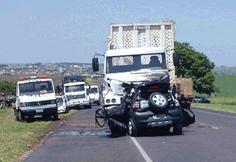
In our case there had been four serious injuries. The three potential claimants in the insured's vehicle, plus one potential claimant from the other car in the accident. The three potential claimants from the insured's vehicle all had serious injuries, broken bones, hospital stays, and astronomical medical bills; the claimant from the other vehicle had some knee pain and a surgical recommendation for an ACL repair. Predictably, there was not enough money to go around as the insured had $50,000.00 in aggregate liability limits (considerably more than most people but woefully insufficient to fully compensate any of the claimants for their injuries). The carrier in our case conducted an investigation, reviewed the accident report, interviewed the participants, sent correspondence to all the parties, and considered who was at fault. They hired defense counsel for their insured, kept the insured informed, and scheduled a mediation where they attempted to settle all of the claims within the $50,000.00 limit.
The single claimant (with the least serious injuries) walked away from mediation without a settlement and pursued her claim against the insured. She ultimate received a judgment against the insured approaching $90,000.00. The other three claimants allowed the insurance company to retain a few thousand dollars from the 50k to try and settle with the one claimant who would not settle at mediation. This is where the greatest problem in a Farinas style bad faith case arises, how do you prove what occurred at mediation, specifically, that an offer and attempt to settle all the claims actually took place. Florida Courts like those in many states have been loathe to invade any mediation privilege (an earlier statute in Florida only kept mediation which was conducted during litigation confidential); so an insurer is seemingly without recourse to prove that reasonable attmepts to settle all claims took place at a mediation. As the insurer did in our case, all of the correspondence prior to mediation and afterwards should indicate that it is the purpose of the mediation to settle "all of the claims." This is also the province of a "bad faith expert" who can explain the purpose of the mediation as well as the reasonableness standard for investigation and communication with the client. The jury must/should conclude that the insurer would not have invited the claimant to the mediation if they did not intend to settle with the individual. A jury of laypeople unfamiliar with the process may not take that step.
In our case there had been four serious injuries. The three potential claimants in the insured's vehicle, plus one potential claimant from the other car in the accident. The three potential claimants from the insured's vehicle all had serious injuries, broken bones, hospital stays, and astronomical medical bills; the claimant from the other vehicle had some knee pain and a surgical recommendation for an ACL repair. Predictably, there was not enough money to go around as the insured had $50,000.00 in aggregate liability limits (considerably more than most people but woefully insufficient to fully compensate any of the claimants for their injuries). The carrier in our case conducted an investigation, reviewed the accident report, interviewed the participants, sent correspondence to all the parties, and considered who was at fault. They hired defense counsel for their insured, kept the insured informed, and scheduled a mediation where they attempted to settle all of the claims within the $50,000.00 limit.
The single claimant (with the least serious injuries) walked away from mediation without a settlement and pursued her claim against the insured. She ultimate received a judgment against the insured approaching $90,000.00. The other three claimants allowed the insurance company to retain a few thousand dollars from the 50k to try and settle with the one claimant who would not settle at mediation. This is where the greatest problem in a Farinas style bad faith case arises, how do you prove what occurred at mediation, specifically, that an offer and attempt to settle all the claims actually took place. Florida Courts like those in many states have been loathe to invade any mediation privilege (an earlier statute in Florida only kept mediation which was conducted during litigation confidential); so an insurer is seemingly without recourse to prove that reasonable attmepts to settle all claims took place at a mediation. As the insurer did in our case, all of the correspondence prior to mediation and afterwards should indicate that it is the purpose of the mediation to settle "all of the claims." This is also the province of a "bad faith expert" who can explain the purpose of the mediation as well as the reasonableness standard for investigation and communication with the client. The jury must/should conclude that the insurer would not have invited the claimant to the mediation if they did not intend to settle with the individual. A jury of laypeople unfamiliar with the process may not take that step.
In our case, all three claimants who did settle had sent demands stating that they would pursue bad faith damages if the carrier did not tender its limits by a date certain. The carrier was able to then arrange the mediation before that date passed. The majority of the jury did not understand the complexity of the Farinas fact pattern. Additionally, despite diligent questioning during voir dire, two jurors revealed after the trial that two others would never side with the carrier regardless of the facts. We ended with a hung jury after hours of deliberation and an instruction in response to juror questions that they should look at the "totality" of the circumstances. I should also note that this case did not involve an assignment of rights to file the suit from the insured to the claimant/judgment creditor which would have increased the risks involved by allowing the Plaintiff to collect attorney's fees in the event of a verdict in their favor. From the defense perspective I consider it a win based on the two predisposed jurors and we came away with some important lessons.
- There is a great advantage in the third party format because of the jurors inability to negotiate the value of the claim among themselves, it's an up or down vote.
- Time must be taken to explain to the jurors the limitations of a carrier when investigating the claim, i.e., they cna only get records a claimant is willing to provide them and whether an investigation is reasonable or not can be determined by the end result for the insured. (Nobody argued that the exposure for the insured wasn't appropriately reduced by the settlements).
- A hung jury may be the best possible result at any bad faith trial.


